
The Everything Gateway | Fintech Inside #113
On Stripe leaning into becoming the default economic stack for AI-native companies, from payments and stablecoins to model routing and agentic commerce.

Hi Insiders, I’m Osborne, an investor in early-stage startups.
Welcome to the 113th edition of Fintech Inside. Fintech Inside provides nuance and insight on the big trends shaping financial services.
Stripe is a payments company, right? On its website, Stripe describes itself as “financial infrastructure”, then as “economic infrastructure for AI” and “backbone of global commerce”. All of those descriptions are true and incomplete at the same time. Especially with Stripe’s recent moves.
Over the last year, Stripe has pushed hard into stablecoins with Bridge, Tempo and OpenStandard. It’s pushed into company formation with Atlas. It’s quietly built out Projects and Privy for developers provisioning AI-native infrastructure.
And now, in the span of a single month, it’s reportedly in talks to spend close to $10 billion acquiring OpenRouter, the largest AI model marketplace, while simultaneously teaming up with Advent International on a $53.4 billion bid for PayPal. Most companies pick one direction to bet on. Stripe is leaning into all of them at once, and hard.
In this edition, I try to make sense of Stripe’s bold ambitions, the case for both acquisitions, and where I think the math actually lands.
Thank you for supporting me and sticking around. Enjoy another satisfying week in fintech.
Considering angel investing or investing in funds? I get a bunch of founders reaching out to me for investors. I’d be happy to put you in touch. Send me a DM here.
🤔 One Big Thought
Stripe - The Everything Gateway
Stripe, the payment gateway
Stripe is described as a payments company. That description captures the entry point, but misses the ambition.
Stripe started by making it easy for an internet business to accept a payment. Then it added bank accounts, cards, invoicing, tax and treasury, on the logic that a business already moving money through Stripe shouldn’t need to leave Stripe to bank.
Then it added Capital, because a business Stripe already understands is one it can underwrite better than an outside lender. Then it went after the moment a company is started: Atlas now forms roughly a quarter of new Delaware corporations, and a company that starts on Stripe tends to stay on Stripe for everything that follows.
Then it went after the rails underneath the dollar itself, buying Bridge, launching Tempo, and then co-founding OpenStandard, because stablecoins are starting to move real volume.
Each of those moves look like diversification. But I think, they’re the same move repeated: find the next layer where money, business, or the infrastructure businesses run on, or money changes hands on, and make it hard to avoid Stripe there.
Stripe’s own annual letter calls this expanding the “GDP of the internet.” That’s a fair description. Each layer doesn’t just capture more of existing commerce, it makes more commerce possible in the first place by removing a piece of friction from starting, banking, or growing a business.
Now Stripe is making the same move into a new layer. It’s reportedly in talks to spend close to $10bn acquiring OpenRouter, the largest AI model marketplace and routing layer. Separately, it’s teamed up with Advent International on a $53.4bn bid for PayPal.
The OpenRouter deal is about margin. The PayPal deal is about consumers - something Stripe has never had.
Stripe, the AI Gateway
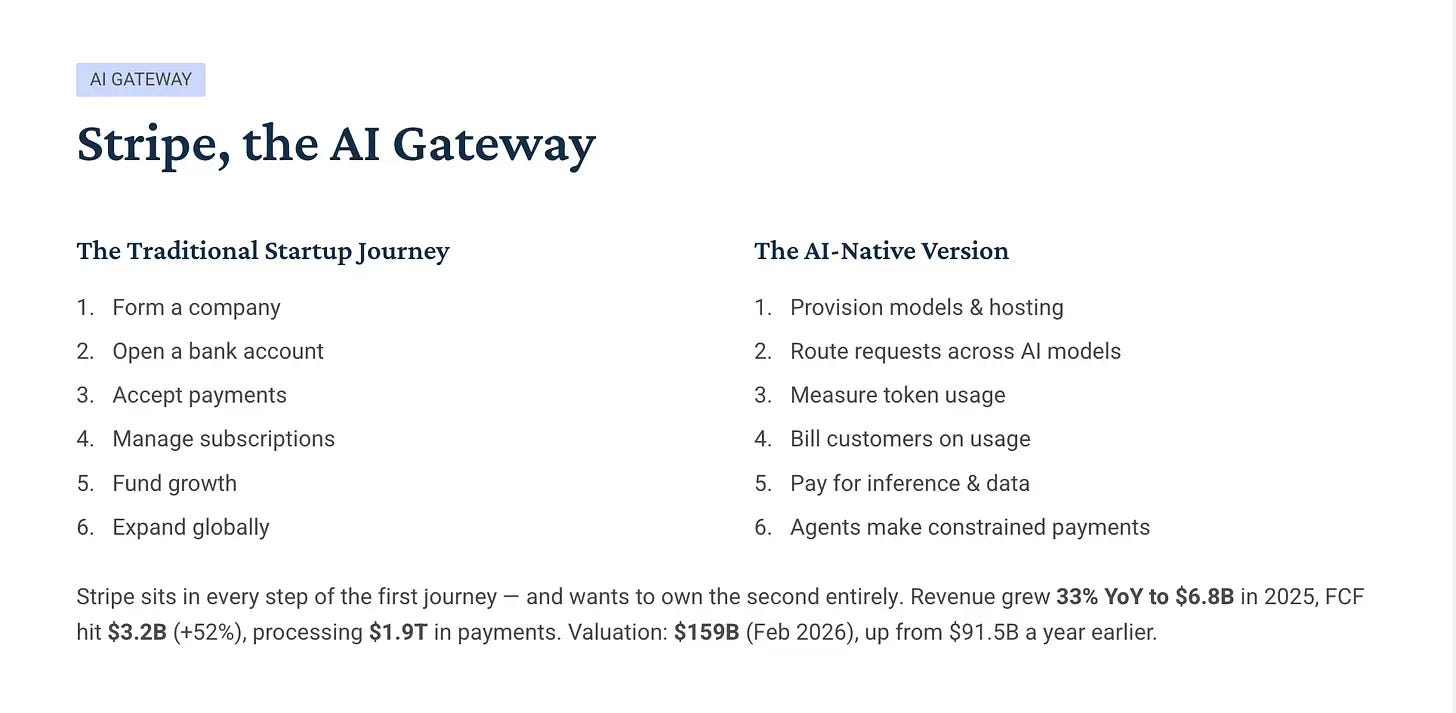
For the last decade and a half, the basic startup journey has looked something like this:
Form a company.
Open a bank account.
Accept payments.
Manage subscriptions and invoices.
Fund growth.
Expand globally.
Stripe increasingly sits somewhere in each of those steps.
Now consider the AI-native version:
Form a company.
Provision a database, model provider, hosting stack and credentials.
Route requests across multiple AI models.
Measure token usage.
Bill customers based on usage.
Pay for data, inference and other machine services.
Eventually, allow software agents to make constrained payments themselves.
The first journey is Stripe’s existing business. The second is what Stripe believes companies are headed and where Stripe wants to be too.
AI is accelerating an already an enormous business
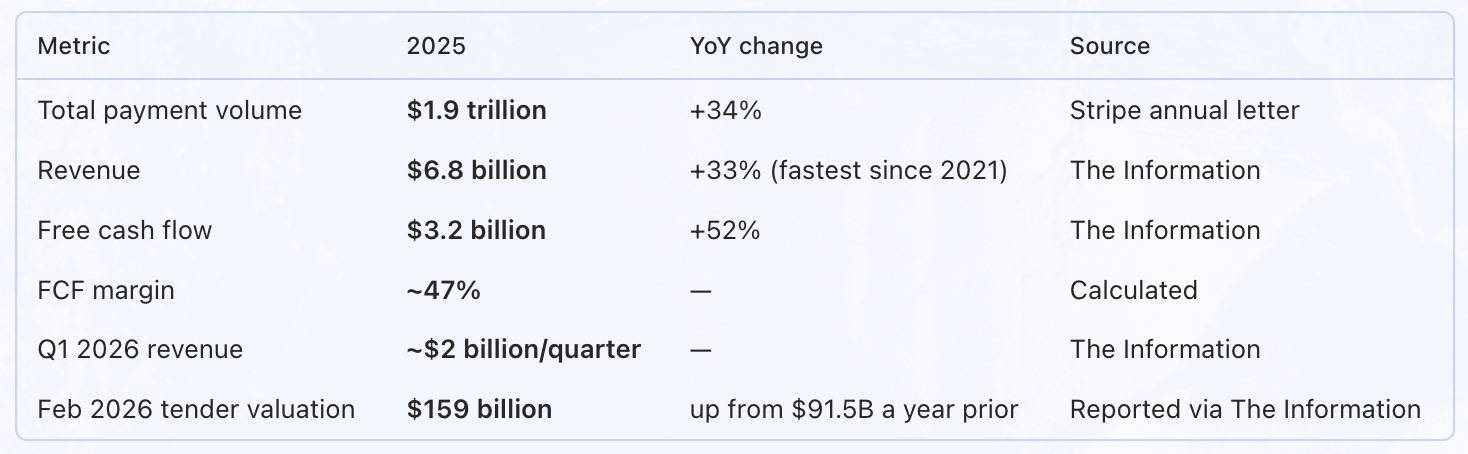
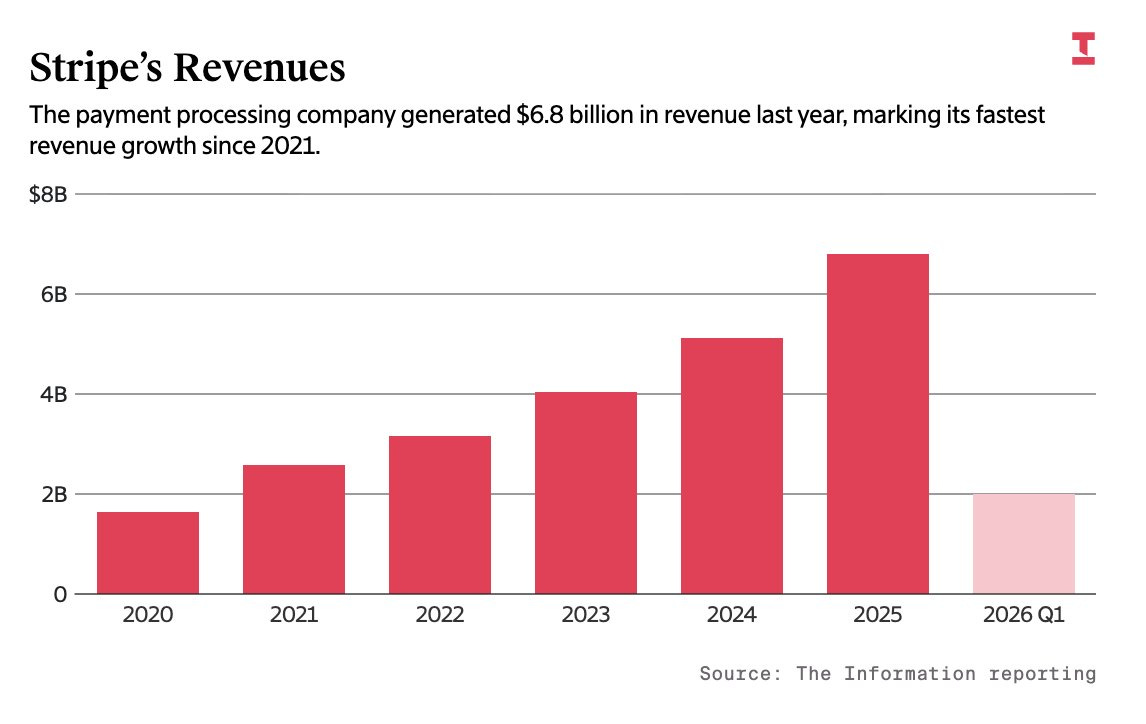
Stripe’s revenue grew 33% YoY to $6.8bn in 2025, its fastest growth since 2021, with Q1 2026 already running near $2bn a quarter. Free cash flow hit $3.2bn, up 52%. Cash generation is outrunning revenue growth. It processed $1.9tn payment value in 2025 and is about 1.6% of global GDP.
And Stripe’s growth is accelerating, not decelerating, at a staggering pace, typically seen only in early stage companies. Stripe is not just growing, it is becoming more profitable as it scales.
The company was last (Feb 2026) valued at $159bn, up from $91.5bn a year earlier, about 8.4% of payment value. It’s a premium valuation but for a company that’s growing at breakneck pace.
AI growth is a real part of the acceleration though. Stripe processes billing for OpenAI and Anthropic directly, the largest companies in this AI race, but also for virtually every other AI company out there including Perplexity, ElevenLabs, Cursor, Midjourney, Supabase and more.
It’s annual letter says the 2025 cohort of new Stripe businesses is growing about 50% faster than 2024’s, with the number of companies hitting $10M ARR within three months of launch doubling year over year. The only other private company numbers that look more exciting are OpenAI and Anthropic’s numbers.
Stripe is not just processing AI payments, it is basically the backbone of the explosion of AI and ensuring the AI economy growth compounds. True financial services!
OpenRouter: margins + default AI gateway
Colin, cofounder of Clerk.com framed it precisely: "Stripe has two angles: 1. Increase the GDP of the internet. 2. The less discussed: Increase their margins on the GDP of the internet."


Payments are a low-margin business - typically between 30-75bps in net take rate on payments value. $6.8B of revenue on $1.9T of volume works out to about 36 basis points.
OpenRouter charges a 5.5% platform fee on credit purchases or 550 basis points, 10 to 18x Stripe’s margin on payments. Net of OpenRouter’s own costs, the realistic margin is probably 200-300 bps. Even at the low end, that’s roughly a 10x improvement per dollar of volume over processing a card.
If an AI-native company processes $100M in payment value through Stripe, Stripe might earn $300,000–$500,000 in net revenue (at 30–50bps). But if that same company routes $100M in inference spend through OpenRouter, the platform fee alone would be approximately $2-2.5M.
The volume behind that number is growing at the speed of light. Deedy, Partner at Menlo Ventures, shows OpenRouter’s token throughput going from 2tn tokens a month at its January 2025 seed round to 250tn by July 2026, 125x growth in 18 months.
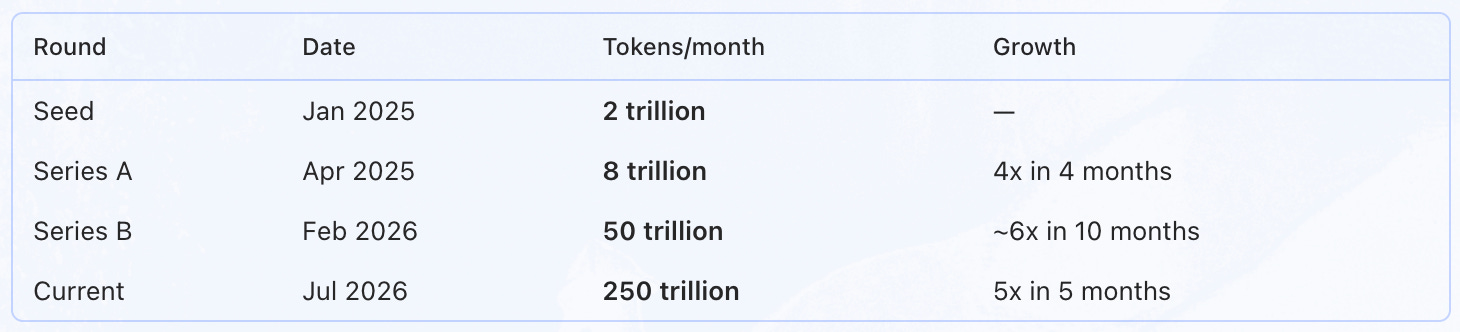
That is 125x growth in 18 months. At 250tn tokens per month, OpenRouter is routing an extraordinary volume of AI work - and it’s compounding!
At $10bn, the price is 3.1x Stripe’s annual free cash flow and a 7.7x jump from OpenRouter’s own $1.3bn Series B two months earlier. For a company generating $3.2bn in free cash flow and growing it 52% a year, paying up for a business line running at 6 to 10x the margin isn’t much of a stretch.
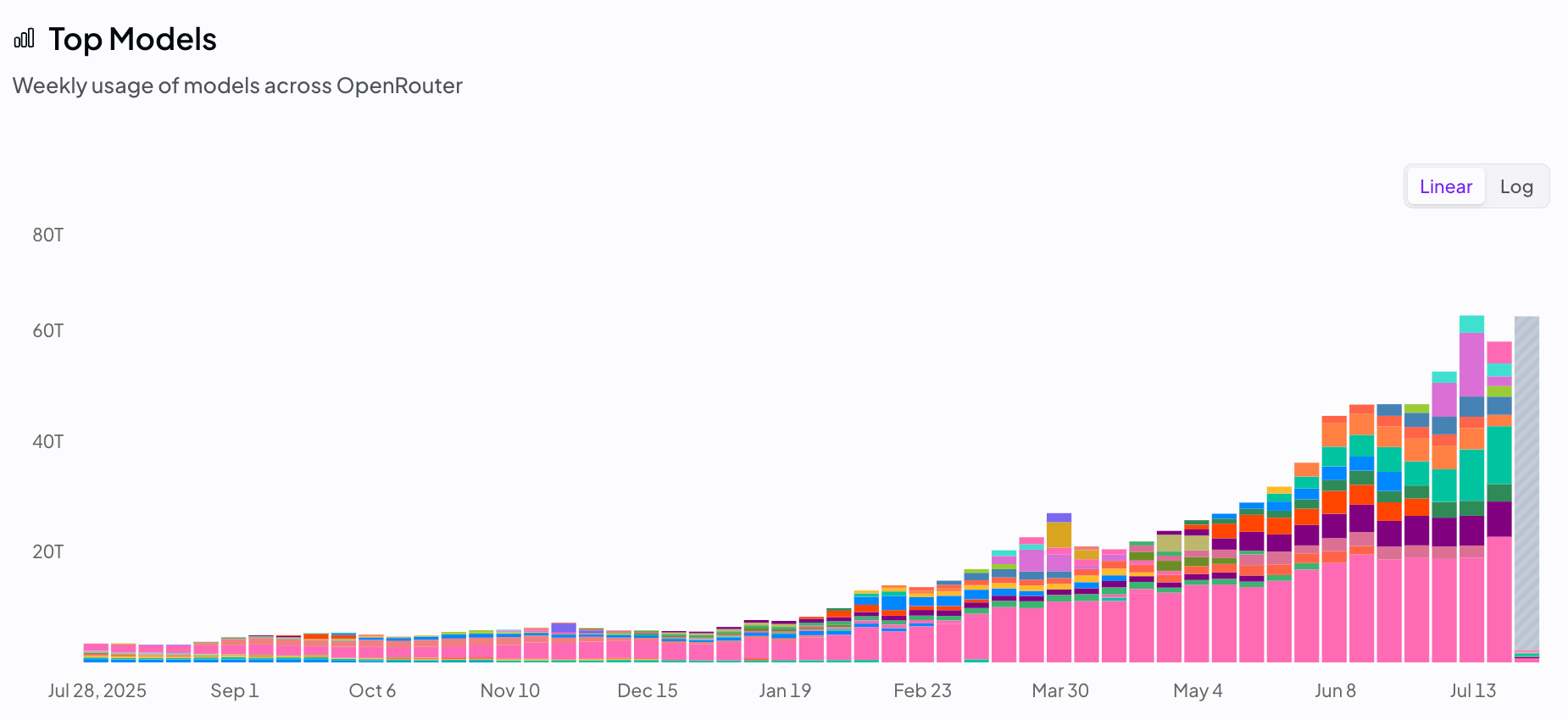
The more important piece of the OpenRouter acquisition story is that Stripe gets to be the “default” AI gateway. Think of this from two vectors: 1. more AI companies are being founded, and 2. Agents are the new users.
If more AI companies are being founded or AI is the default way to build, then OpenRouter becomes key to the “infrastructure” of starting up. Stripe gets to offer this AI gateway to 25% of all companies incorporated in Delaware that used Atlas. When Stripe launched Projects.dev, it was a head scratcher, and I just dismissed it as “vibecoding allows you to just launch things”. But now it makes sense to me.
If Stripe becomes the layer through which developers provision services (Projects), select models (OpenRouter), manage credentials (Projects + Privy), meter usage (Metronome), and pay for services (Payments + Bridge + Tempo + MPP), it gets closer to the centre of an AI-native company’s operating system — and it earns higher margins at each step.
More reasons to stay within the Stripe ecosystem. That’s more inertia to switch away from Stripe. That’s more margin for Stripe from the same customer. Prasenjit Sarkar noted on X: “The AI model routing layer is becoming as critical as the payment layer.”
If agents are the new users, then owning that AI gateway becomes crucial too. As I’ve written in Edition #93 (Agentic Payments) back in may 2025, Stripe has been building products for agentic payments too. It’s already launched Agentic Commerce Protocol in partnership with OpenAI. It’s also launched an Agentic payments toolkit to embed agentic payments in the workflow. There’s an awesome video of Stripe demo’ing this metered billing and agent flow. Owning the AI gateway that your apps use and owning the payment gateway that agents use to pay/get paid is a big lock in. That’s a large part of the value chain that Stripe gets to own.
It’s important to note that OpenRouter had an estimated $50M ARR in Apr, 2026. Assuming that number has grown to even an absurd number of $75-100M ARR, given how token usage on OpenRouter has grown, at a $10Bn valuation it’s 100-150x revenue multiple. Besides, every large AI company is also building their own AI gateways - from Vercel to Cursor to AWS to Google and Cloudflare and you name it.

The valuation seems rich given competition and OpenRouter’s revenue scale, but if you get to 10x your margin profile, acquire 8M+ developer distribution and become the default AI gateway - that’s a pretty good deal.
Stripe, the consumer gateway
The PayPal bid is a different kind of move, and it deserves a more deeper examination.
Per Reuters and TechCrunch, the key facts are:
Offer price: ~$53.4bn ($60.50 per share), 28% over PayPal’s July 14th close
Structure: Stripe and Advent International (a PE firm) to share ownership equally. Per Yahoo Finance and Fintech Brainfood, the deal is financed by about $50bn in committed bank debt that lands on PayPal's own balance sheet, plus a $17bn equity check split between Stripe, Advent International and Block. Stripe and Advent hold the equity jointly and equally. Stripe's actual cash outlay looks closer to single-digit billions, and none of PayPal's debt touches Stripe's own books.
PayPal’s state: Stock down 40%+ over 12 months; market cap had fallen from ~$360B peak (2021) to ~$36B low; cutting 20% of workforce (~4,760 roles) to save $1.5B in run-rate costs
So what does that $54bn check buy?
PayPal has ~440M active accounts and processed $1.79tn in 2025 payment volume, almost identical to Stripe's $1.9tn. But PayPal's 2025 net revenue was $33.2bn (growing at 4.3% YoY) against Stripe's $6.8bn (growing at 33% YoY). On nearly the same volume, PayPal earns close to 4.9x Stripe's revenue, because its take rate, about 186 basis points, driven by Venmo, BNPL, value-added services and interest on customer balances, is more than five times Stripe's own 36 bps.
Stripe’s distribution is developer-first and platform-first. It does not naturally own the consumer wallet. PayPal, and especially Venmo, with its social payment graph, would give Stripe a consumer-side identity and payment layer that it has never had. Stripe’s built Link with 250-300M user accounts, but again, it’s not a consumer brand, yet.
If Stripe’s thesis is that agents will increasingly transact on behalf of consumers, then owning a consumer payment brand with PayPal’s scale creates a direct path from agent to wallet and vice versa. Stripe’s annual letter describes the Agentic Commerce Protocol (ACP), co-developed with OpenAI, as “open by design, working across payment providers and AI platforms.” PayPal could be the consumer rail.
Combine the two and revenue is close to $40bn, with 440M consumer accounts, ~$3.8tn in annual payments value (~3% of global GDP) and a consumer wallet Stripe has never owned on its own. The case here isn’t only distribution. It’s distribution sitting on a revenue base that already monetises at a higher rate than Stripe’s own core business.
It can also be argued that PayPal is being acquired at a steal right now at just 3.0% of payment value, compared to Stripe’s premium valuation at 8.4% of payment value. Even if Stripe+Advent are compelled to up their bid, given PayPal’s board rejected the initial bid, at $60-65bn, that’s still only 3.3-3.6% of payment value. Obviously these are huge numbers, and if it culminates at anything higher than the initial bid, it will be the largest fintech acquisition ever.
The case against is just as concrete. PayPal's TPV grew only 7% in 2025 against Stripe's 34%, and its stock had fallen roughly 90% from its 2021 peak before the bid arrived. PitchBook called the offer "not irresistible".
There's also a culture question worth taking seriously. Disruption Banking framed the deal as "the challenger swallow the pioneer," and the plan to leave PayPal fully intact, Venmo, Braintree and PYUSD all continuing to operate as they do today, reads less like an integration plan and more like an arm's-length holding.
Stripe runs a tight, engineering-first culture. PayPal is a 25-year-old public company that just replaced its CEO and split itself into three business units mid-turnaround. Keeping the two separate may say less about strategy and more about how hard those cultures would be to merge.
OpenRouter seems like the easier decision. It's affordable against Stripe's cash flow and pulls the margin mix in the right direction. PayPal is a better-structured bet than the headline number suggests, and the revenue math, given the near-identical volume, is compelling.
But it's still a slower business, run by a team that doesn't share Stripe's culture, held at arm's length instead of folded in. It reads less like Stripe building a product and more like Stripe buying a call option on consumer distribution. Stripe and Advent could be testing whether PayPal can be acquired at a lower price.
Stripe, the cross border gateway
Stripe’s stablecoin strategy is not incidental either. It is the bridge between geographies and human money and machine money.
I covered this in Edition #111 (OUSD and Stablecoins). Open USD (OUSD), announced on June 30, 2026 by Open Standard, is a new stablecoin designed for global money movement with three principles: mint/redeem at no cost, partners earn reserve revenue by default, and governance is collaborative.
Stripe is both a launch partner and deeply connected to OUSD through Bridge and Tempo. This is Stripe ensuring that the stablecoin rail of the future is one it helped design.
The a16z fintech newsletter on the Bridge acquisition made the AI connection explicit: “Stablecoins also offer new infrastructure to help AI agents transcend the limitations of today’s financial infrastructure, which was designed for humans, not AI. For example, when an AI agent wants to make a payment on your behalf, whose card or wallet does it use? Who authorises the transaction? Where in the transaction does the risk sit? What if an AI agent wants to pay another AI agent? Stablecoins can help solve these problems.”
Stripe’s annual letter reinforces the scale of ambition: “we expect agents will most likely soon be responsible for most internet transactions, and we will likely need blockchains that support more than one million — or even one billion — transactions per second.”
Stripe’s walled garden: each layer compounds the inertia
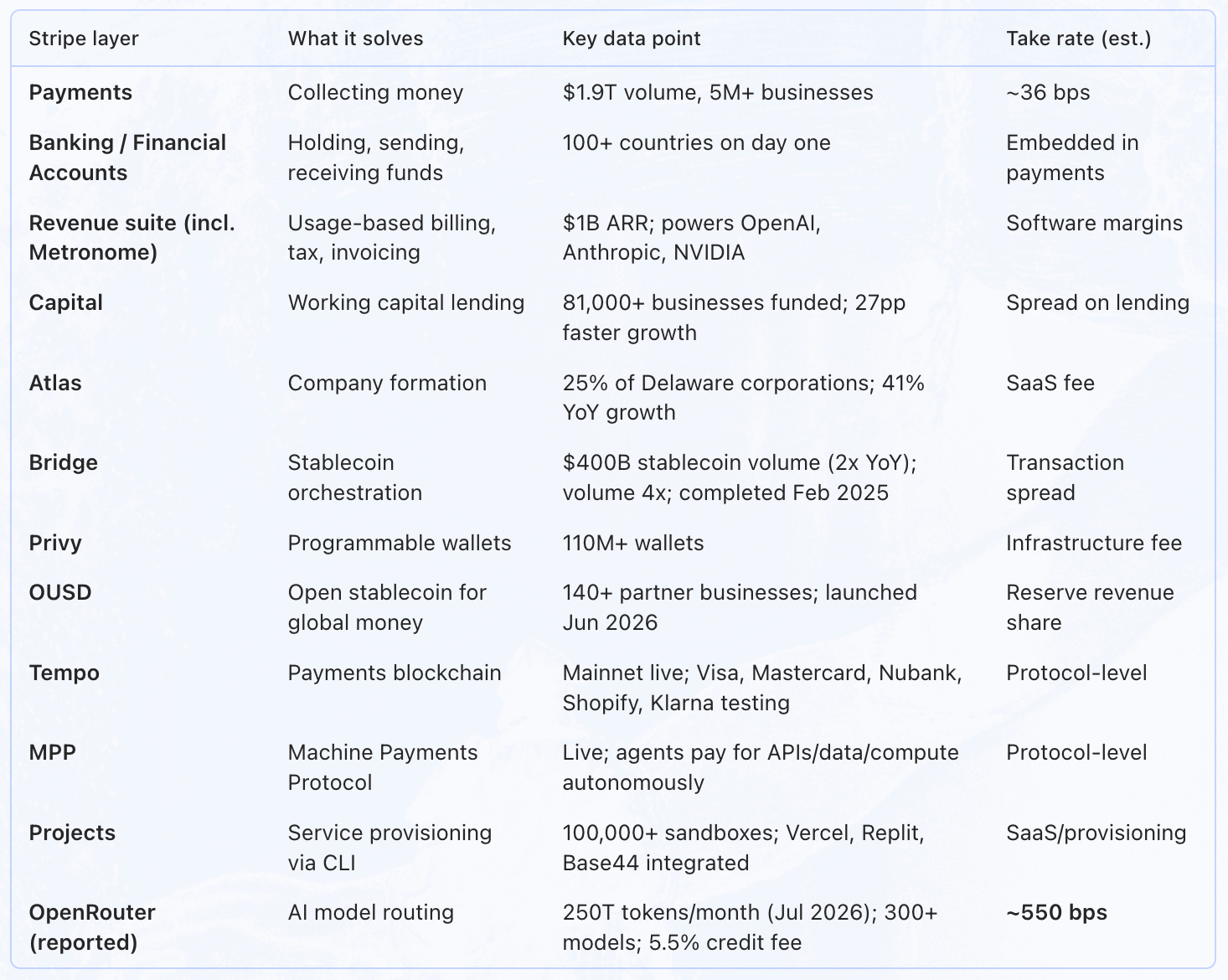
Nobody rips out payment infrastructure once it's live. You add a second provider before you ever remove the first. That's the inertia Stripe has sold to finance teams for years. The same logic applies one layer up now. Once a product is built around a router deciding which model handles which task, swapping the router means re-testing every workflow downstream.
Each layer Stripe adds either deepens inertia (Atlas, Projects, Capital) or opens a higher-margin revenue stream (OpenRouter, Bridge, OUSD).
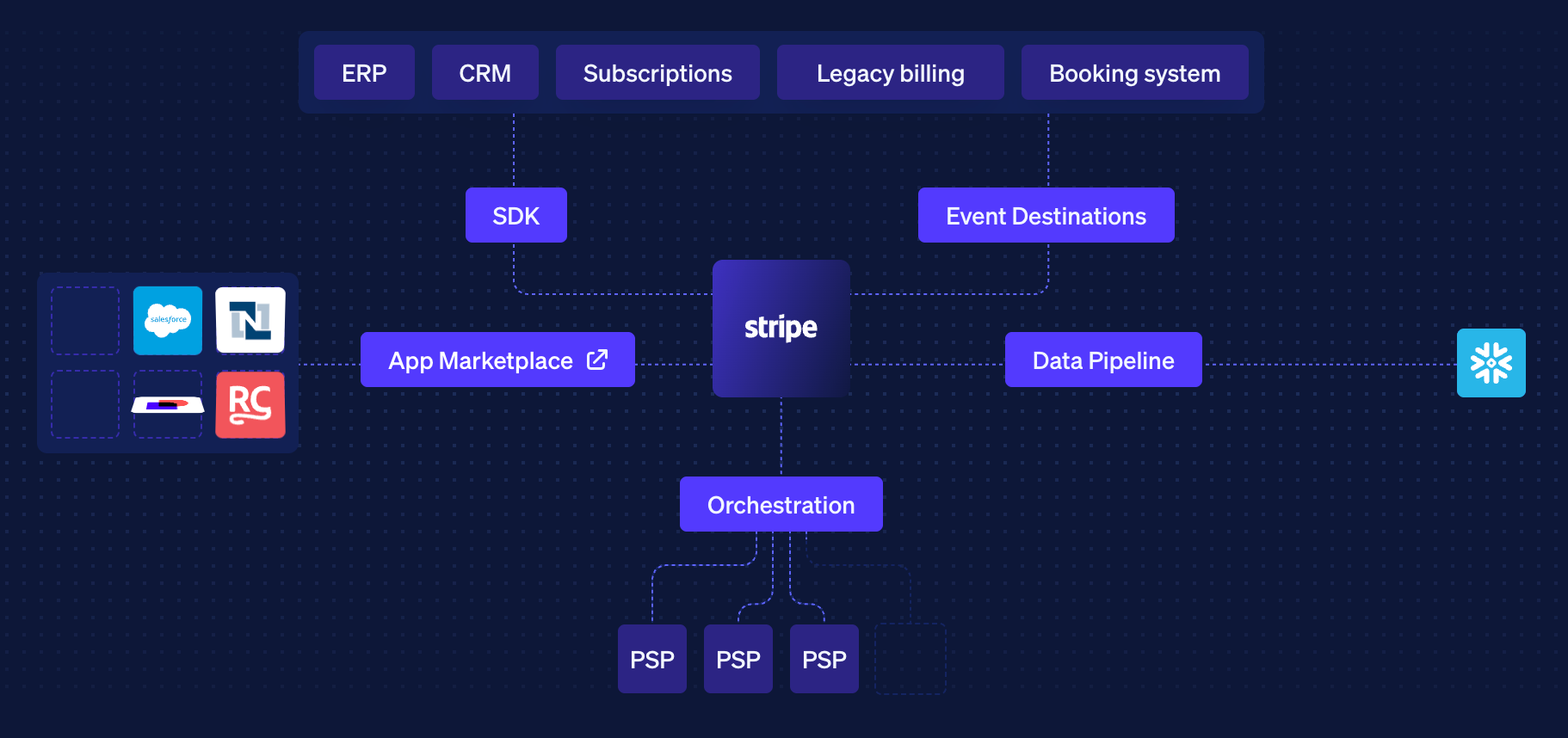
The takeaway
Stripe’s original insight was that payment acceptance was complicated for internet companies.
Its newer insight may be that the AI economy will be too fragmented for developers and agents, and that the fragmentation itself is an opportunity for the company that can aggregate it.
The margin math is the key. Payments earns Stripe roughly 36 basis points on $1.9 trillion. AI routing could expand that margin profile significantly, on a pool of inference spend that is growing.
The pattern underneath both deals is the one Stripe has run for over a decade: find the next layer where value changes hands, and become hard to avoid there too.
The question is whether Stripe can integrate a consumer payments giant and an AI model marketplace simultaneously, or whether one of those bets will end up defining the company’s next decade and the other will be remembered as a distraction.
Whether Stripe buys OpenRouter or PayPal is not important. It is whether Stripe can make itself the default place where an AI-native company turns tokens into a business.
1-min Feedback: Your feedback helps me improve this newsletter. Click UPVOTE 👍🏽 or DOWNVOTE 👎🏽
🎵 Song on Loop
Good background songs to listen as you read Fintech Inside: This week I stumbled upon Magnus Ferrell’s Asleep Talking (Youtube). The song is a smooth, easy listen. Good for a slow weekend. Magnus is Will Ferrell’s son btw! Dad’s a comedic genius, and son’s dishing out banger hits. Love it!
✨ Call Outs
[CHARTS] “Renting is stressful. Millions of renter conversations tell us why” by a16z
[TOOL] PDF with me - fully local pdf tool kit
[POST] I’ve Changed My Mind. Early Stage Venture Funds of $100 Million or Less Should Hold Almost No Reserves for Follow-On by HunterWalk
[POST] The age of the solopreneur by Stripe Econ
[SHOW] Maximum Pleasure Guaranteed on Apple TV
[COURSE] Stanford MS&E435 Economics of the AI Supercycle | Spring 2026 | Economics of Generative AI
👋🏾 That’s All Folks
If you’ve made it this far - thanks! As always, you can always reach me via DM at osborne.vc/dm. I’d genuinely appreciate any and all feedback. If you liked what you read, please consider sharing or subscribing.
1-min Feedback: Your feedback helps me improve this newsletter. Click UPVOTE 👍🏽 or DOWNVOTE 👎🏽
See you in the next edition.
Hi Osborne,
Great connecting with you! I came across Fintech Inside and really appreciate your insights on fintech, investing, startups, and the evolving financial ecosystem. Your perspectives on founders, innovation, and the future of financial services are truly valuable.
I’m also writing and working in the fintech and crypto space, exploring topics around digital payments, blockchain, embedded finance, and the future of money. I’d love to stay connected, support each other’s work, and subscribe to each other’s content.
It would be great to explore potential collaboration opportunities down the line, whether through content, knowledge sharing, or fintech discussions.
Looking forward to staying connected!
Hi Osborne,
Great connecting with you. I’ve been following Fintech Inside and really appreciate your perspectives on fintech, financial services, and the deeper business models shaping the industry. Your insights around trust, infrastructure, and the future of financial services are especially interesting.
I’m also working and writing in the fintech and crypto space, focusing on digital payments, financial infrastructure, banking innovation, and emerging trends in the future of money.
I’d love to stay connected, exchange ideas, and support each other’s work. I’ve subscribed to your newsletter and look forward to learning from your insights. I’d be happy to share my work as well.
Would you be open to exploring a collaboration down the line?
Looking forward to staying connected!