

Hi Insiders, I’m Osborne, an investor in early stage startups.
Welcome to the 103rd edition of Fintech Inside. Fintech Inside is the front page of Fintech in emerging markets.
This week's piece comes from a conversation I've been having on repeat. Seed-stage founders building different products, across different sectors, all asking the same thing: how do we compete against entrenched players? Decided to write down what I usually tell them.
The answer matters more now than it did three years ago. The incumbents founders are competing against today aren't just banks with legacy tech. They're well-funded fintechs with real distribution and deep data moats.
I believe there are three structural levers: 1. Attack the margin profile, 2. Compress time to money, 3. Deliver a “Delta 4” experience.
The breakout companies almost always do one of three things differently. Often two.
If you're building in fintech right now, or thinking about it, this is the lens I'd use to pressure-test whether your startup has a real edge.
Thank you for supporting me and sticking around. Enjoy another satisfying week in fintech!
Considering angel investing? I get a bunch of fintech founders reaching out to me for investors. I’d be happy to put you in touch. Send me a DM here.
🤔 One Big Thought
Three ways a startup can compete against incumbents
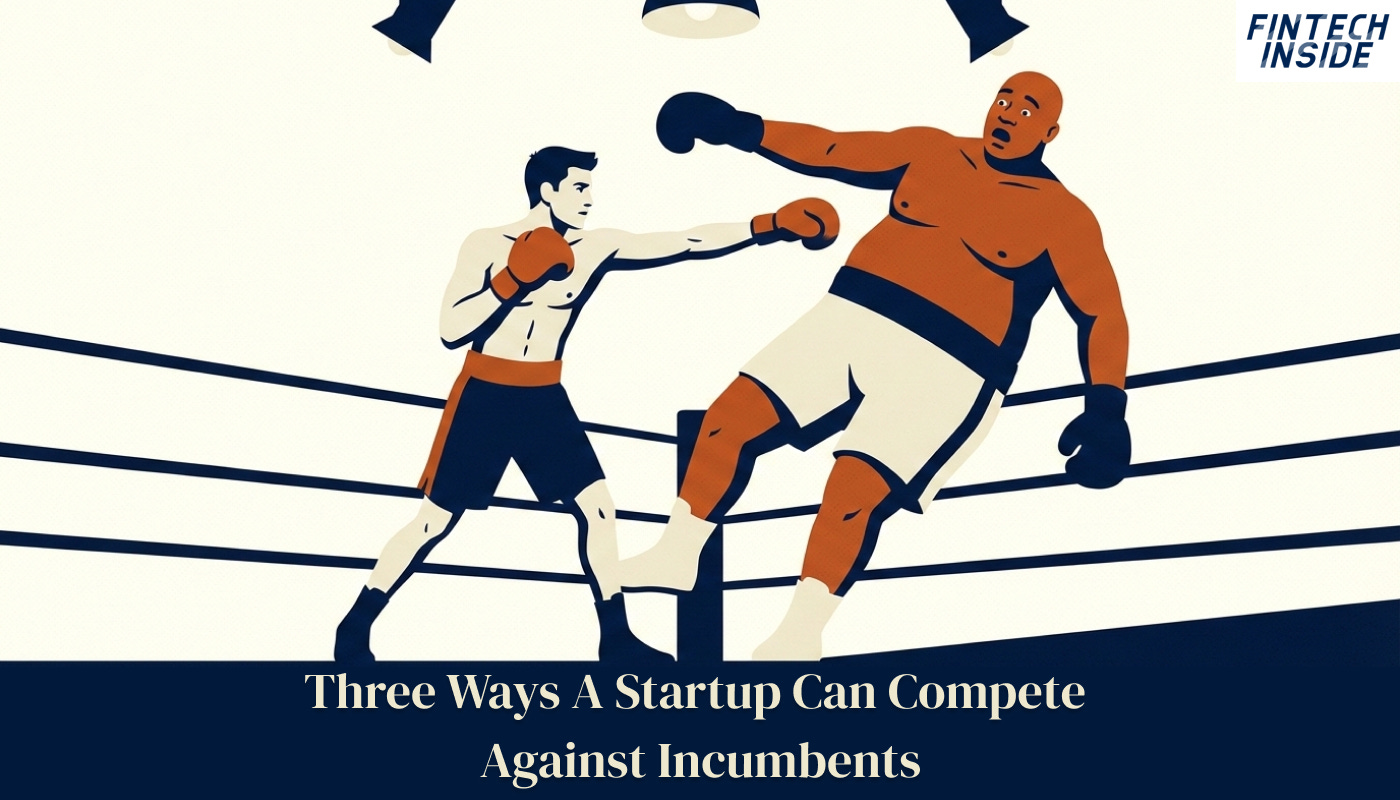
If I had a dollar for every time a seed-stage founder asked me “How do we compete against incumbents?” I’d have enough to start my own venture fund!
Over the past year, I’ve had this conversation with several founders. Different sectors. Different products. Same anxiety. And honestly, I understand the anxiety. When you’re at the seed stage, the incumbents feel enormous. They have the customers, the data, the regulatory relationships, the brand. You have a pitch deck and a Notion doc.
Over the past decade, competition have become tougher. Earlier, the question used to be about banks. Founders would ask how to compete with SBI or HDFC or ICICI, and I’d walk them through the typical playbook: banks are slow, their tech is old, their customer experience is terrible, there are gaps everywhere.
That conversation has changed. Now, increasingly, it’s: “How do we compete with the new fintech incumbents?”
PhonePe. Razorpay. Zerodha. CRED. Groww.
That second question is harder. These companies don’t have the same weaknesses as banks. They’re tech-first. Well-funded. Distribution-heavy. Data-rich. They’ve already crossed the trust threshold with the customer segment you’re probably targeting.
Last month, a founder building in the SME lending space put it simply: “The banks don’t scare me. PhonePe scares me.”
So how does a seed-stage startup, with limited capital, no brand, and no distribution, realistically compete and win against an incumbent and a new incumbent?
I’ve been thinking about this for a while, and I keep coming back to the same framework. I think there are only three structural ways a startup can compete against an incumbent:
Attack the margin profile
Compress time to money
Deliver a “Delta 4” experience
I want to be precise about the word “structural” here. I’m not talking about having a better sales team, a sharper brand, or a more charismatic founder. Those things matter, but they’re tactical advantages. They can be copied or hired away.
Structural advantages are rooted in how your business is built. They’re hard to replicate because matching them would require the incumbent to change something foundational about how they operate.
And these structural advantages come from spending time with users. I’ve written about extensively in Edition #65 on Unique Insights.
Everything else is tactics. Let’s walk through each one.
1. Attack the Margin Profile
Let’s start from first principles.
An incumbent’s pricing reflects their cost base, their distribution model, their risk appetite, and their shareholder return expectations. These aren’t strategic choices that a CEO can reverse in a board meeting.
Unless you’re Sergey Brin and you own majority of the voting class shares. Then, yes, you can decide unilaterally to spend several hundred billion dollars to save your company from getting pummelled in a new technological transition.
But for the rest of us mere mortals, the cost base is a structural constraint baked into how the business runs. The branch network costs what it costs. The relationship managers need salaries. The investors expect a certain ROE.
This means every incumbent has a price floor: the minimum they need to charge to keep the business viable.
If a bank needs 600 bps on a lending product to cover origination, servicing, credit losses, and return expectations, and you can build a business that works at 300 bps, you don’t need to be better at anything else. You don’t need better marketing, a slicker app, or a bigger brand. You just need to exist at that price point, and a certain segment of the market will find you.
This is what I mean by structural asymmetry. Your cost structure makes possible a price point that the incumbent literally cannot sustain without breaking their P&L. They’d have to fire their RMs, close their branches, and renegotiate their investor returns to match you. That takes years, , if it happens at all. But more importantly, it requires risk-taking leadership.
Zerodha, from back in 2010’s, is the cleanest Indian example.
Flat ₹20 brokerage. No relationship manager model. No branch network. Bootstrapped from day one, which meant no investor pressure to juice margins for a fundraise. By 2024, Zerodha had over 7.8M active clients, roughly 15% of all active demat accounts in India. Full-service brokers like ICICI Direct or HDFC Securities, with their heavy cost structures and RM models, couldn’t match that pricing without gutting their existing revenue streams.
Nithin Kamath didn’t out-feature them. He built a fundamentally different cost structure and let the pricing speak for itself and still became the most profitable stock broker. Today, their operating stack is base expectation. You’ll rarely find a stock broker veer too far away from this model.
Wise (formerly TransferWise) did this globally for cross-border payments.
Banks price international transfers at opaque spreads of 3–5% (PayPal is/was at 10%), bundled into the exchange rate so you don’t even see the fee. The opacity is the business model. Wise offered the real mid-market FX rate plus a transparent fee, typically under 1%.
By 2024, Wise was processing over $35bn in cross-border volume per quarter, growing ~20% YoY. Lower margin per transaction, but higher trust and higher volume. The transparency itself became a competitive moat because once a customer sees the real rate, the bank’s opaque pricing feels like a scam.
They changed the unit economics of the entire category.
One thing to flag for founders: margin attack only works when your cost structure is fundamentally different. I see a lot of startups that think they’re doing margin attack by offering the product for free hoping to raise prices later, but they’re actually just spending capital to subsidise lower prices. That’s not the same thing. If your free/low pricing depends on your next funding round, you don’t have a structural advantage. You have a runway problem.
The 2021 vintage taught us this clearly. Dozens of fintechs offered zero-fee or heavily subsidised products, grew fast, and then had to raise prices when funding dried up in 2022-23. Customers churned. The incumbents are still standing.
Real margin attack means you can charge less and still make money because of how your business is built.
2. Compress Time to Money
In fintech, trust doesn’t build when users download an app. It doesn’t build when users browse the interface or read the onboarding screens.
Trust builds when money moves.
I’ve been thinking about this a lot lately because of how many pitches I see where the founder obsesses over “engagement” and “DAUs” without talking about the speed of the first transaction. A user who downloads your app and browses for two weeks is not an engaged user. They’re a user who hasn’t decided if they trust you yet.
Here’s how I define it: Time to money = the time between user signup and first completed transaction.
Why does this matter so much? Because in financial services, the first transaction is the trust event. That’s the moment the user takes a real risk on you. They put their money (or their data, or their credit) in your hands and see what happens. Everything before that is browsing. Everything after that is a relationship.
The shorter this window, the faster habit forms, the faster data accrues, and the faster lifetime value compounds. But there’s something deeper going on too. The first transaction creates a psychological commitment. Once a user has moved money through your app/platform and had a good experience, the switching cost goes up dramatically, even if a competitor offers something marginally better.
In my opinion, time to money is the new CAC. You can spend ₹500 acquiring a user, but if they don’t transact for three days, you’ve effectively lost that spend. The user will forget about you, get distracted by a competitor, or simply lose motivation. Whoever captures the first transaction often captures the relationship.
In the early days, Jar was founded with this thesis.
Their initial premise was to get a user to start saving within 60 seconds. The whole app and product experience was designed to enable that. And it worked. Before Jar, the user was expected to do homework and know which mutual fund to invest in - growth funds, large/small/multi cap funds, what’s the expense ratio, what’s the exit load and so on. That’s a lot of jargon-filled, cognitive load. With Jar, users invested in digital gold - an instrument they know and understand.
Square in the US understood this better than anyone.
Before Square, a small merchant wanting to accept card payments dealt with terminal purchases, paperwork, underwriting, and multi-week waiting periods. The process was designed for large merchants and grudgingly adapted for small ones. Square collapsed all of that. Sign up, plug in the reader, accept your first payment on the same day. By 2023, Square’s seller ecosystem was processing over $200 billion in annualised GPV.
Think about what Square actually did: they didn’t make card acceptance cheaper (their take rate was actually higher than traditional acquiring). They made it faster. The speed of activation was the entire product.
Affirm did this for consumer credit at checkout.
No branch visit. No “we’ll get back to you in 5-7 business days.” Credit approval in seconds, at the point of purchase. The transaction happens instantly. Value is experienced instantly. By the time a traditional lender processes the application, Affirm has already captured the customer and the merchant relationship.
In India, I’d argue Slice (now merged with North East Small Finance Bank) compressed time to money for a generation of first-time credit users. The traditional credit card application (documentation, income proof, 2-3 week approval cycles) got collapsed into minutes. That speed mattered because it built trust before the user had a chance to drop off or second-guess.
CRED did this too, their credit card bill payment experience at launch was instant. Today it’s the standard.
Look at what quick commerce has done in India. Zepto, Blinkit, and Swiggy Instamart compressed delivery from "2-3 days" to "10 minutes," and in doing so, they've permanently rewired consumer expectations. A generation of users now considers 30 minutes slow.
That expectation bleeds into every other category, including financial services. If your fintech product has a 48-hour activation cycle, you're competing against a user whose last commercial experience was a 10-minute delivery, where even the payment (UPI) was instant.
You must be thinking, it’s very hard to compress time to money in financial services - KYC process, onboarding, data sharing and more. It’s a hassle. But we’ve seen so many examples over the years of founders figuring out adjacent products just to keep the user engaged and trust the platform, then get the user to go through the core process. This comes from studying user behaviour and developing insights constantly.
For founders thinking about this lever: map out every step between “user signs up” and “user completes first transaction.” Every form field, every verification step, every waiting period. Each one is a point where you lose people. The companies that win on time to money are ruthless about eliminating steps that don’t directly serve trust or compliance.
3. Deliver a “Delta 4” Experience
This concept is attributed to Kunal Shah. The idea: switching happens when the experience gap between the old way and the new way is so wide that going back feels irrational.
4x better. 10x better. Visibly, unmistakably different.
Most product improvements are incremental. A slightly faster load time. A cleaner settings page. A new feature that 15% of users might try. These improvements matter, but they don’t change behaviour. Users will stick with what they know unless the gap is wide enough to justify the effort of switching. And in financial services, where trust is hard-won and switching costs are real (primary bank accounts, credit lines, investment portfolios), the gap has to be very wide.
I think about Delta 4 slightly differently when evaluating pitches. I look for a specific signal: does the user’s emotional state change? Not just their workflow, but their actual feeling about the category.
Here’s what I mean. If your product makes someone feel smart for the first time in a category that previously made them feel stupid, that’s Delta 4. If your product makes someone feel in control in a category that previously made them feel anxious, that’s Delta 4. The experience gap has to be wide enough that the user can articulate it to a friend without you prompting them. “You have to try this” is the Delta 4 test. If users say it spontaneously, you’re there.
Stripe fits here.
If you were a developer in 2012 trying to integrate payment processing, you were dealing with acquiring banks and gateway APIs that looked like they were designed in 1998. Weeks of back-and-forth. Technical documentation that assumed you had a payments team. Stripe offered seven lines of code, clean documentation, transparent pricing, instant sandbox testing.
The experience gap was wide enough that switching felt inevitable. By 2023, Stripe was processing over $1tn in total payment volume. Developers, who had never been the target customer for payments infrastructure, became the most valuable distribution channel in the category.
Paytm’s Soundbox did this for offline merchant payments in India.
Before the Soundbox, a merchant accepting a digital payment had to stop what they were doing, pick up their phone, unlock it, check the notification, confirm the amount, then go back to serving the next customer. For a busy kirana store or a street food stall during the lunch rush, this was painful.
The Soundbox made payment confirmation audible. “Paytm pe aapko 500 rupaye mile.” The merchant hears it and keeps working. The customer hears it too, which eliminated disputes on the spot. The shift was sensory, not just digital.
By late 2024, Paytm had deployed over 11M soundboxes. And here’s the Delta 4 tell: ask any merchant who has one whether they’d go back to checking their phone. They look at you like you’ve lost your mind. The old way (unlock, scroll, squint, confirm) feels absurd once you’ve experienced the new way (just listen). That’s the one-way door. The entire offline merchant payments category in India reorganised around this single device.
One thing I see founders get wrong: they confuse “good UX” with Delta 4. A cleaner interface or a faster loading time doesn’t qualify. You can polish a product to perfection and still be only 20% better than the incumbent. Delta 4 is a discontinuity. The user cannot imagine going back to the old way. If your users would go back to the incumbent after a month if you disappeared, you haven’t achieved Delta 4.
One lever is an advantage. Two is a moat.
Breakout companies almost always attack at least two of these levers simultaneously. Like a 1-2 in boxing: the first lever creates the opening, the second does the damage. And I think this is the most important part of the framework, because it explains why some startups build durable advantages while others get competed away.
Margin + Speed: Zerodha didn’t just offer cheaper brokerage. The account opening was faster. The execution was faster. The entire experience was built around removing friction alongside cost. An incumbent trying to respond had to simultaneously lower prices and overhaul their tech stack. Most couldn’t do both.
Speed + Delta 4: Affirm at checkout is both instant (time compression) and emotionally different from traditional credit applications (Delta 4). A bank trying to match Affirm can’t just build a faster approval process. They also need to change how the credit decision is surfaced, how the offer is presented, and how the user feels at the moment of purchase.
Margin + Delta 4: Wise is both cheaper and more transparent. The experience of seeing the real exchange rate, after years of hidden bank spreads, creates a trust gap that’s hard for incumbents to close. A bank can’t match Wise’s pricing without revealing how much they were previously overcharging, which creates a brand problem.
This is why two levers together are so powerful. Matching one lever is hard. Matching two at the same time requires the incumbent to change two foundational things about their business simultaneously. Most organisations can barely change one.
If you’re building right now and you can only clearly articulate one of these three advantages, think about the another vector you can add to your offering. Ask yourself: what’s the second lever? If you’re cheap, how fast is your activation? If you’re fast, how wide is the experience gap? If the experience is transformative, can you also be structurally cheaper?
So What Does This Mean If You’re Building Today?
If you’re a founder reading this, the question to ask yourself is: Which structural constraint am I changing?
Be specific. “We have better UX” is not a structural answer. “We can underwrite this segment at 200 bps lower because of [specific data advantage]” is. “Our onboarding gets users to first transaction in 90 seconds versus the incumbent’s 3 days” is. “First-time users in our category say they’d never go back to the old way” is.
If the answer to “which constraint are you changing?” is none of the above, you’re probably competing on better UX. Better UX matters. But incumbents have more money, more time, and more distribution to play that game. You won’t out-brand HDFC or out-market PhonePe. You need a structural edge they can’t easily copy.
I could be wrong about the exact framing here. Maybe there’s a fourth or fifth lever I’m missing. But when I look at the breakout fintech stories, in India and globally, they almost always fit into one of these three buckets.
If you see it differently, I’d love to hear it. What structural advantages have you seen startups exploit that don’t fit this framework?
1-min Anonymous Feedback: Your feedback helps me improve this newsletter. Click UPVOTE 👍🏽 or DOWNVOTE 👎🏽
🎵 Song on loop
Fintech updates can get boring, so here’s an earworm: Judge me all you want but, this week I’ve been hooked on Golden (Youtube / Spotify) from the excellent Netflix movie K-Pop Demon Hunters. There’s also this video by Vanity Fair interviewing the creators of the song where they dissect what went into making the song. It’s really good.
✨ Call outs
[Interview] Varun Mayya’s interview of Demis Hassabis is really good, partly because Varun’s questions were really good. The responses were top notch.
[Article] Sidu Ponnappa, founder of RealFast.AI has something to say about the whole “SaaS is dead” debate. And he makes a really strong point. There is no product. Read all about it.
[Video] Picking off from my last week’s edition on Gold, here’s a video of rare access to the gold vaults at the Bank of England.
👋🏾 That’s all Folks
If you’ve made it this far - thanks! As always, you can always reach me at os@osborne.vc. I’d genuinely appreciate any and all feedback. If you liked what you read, please consider sharing or subscribing.
1-min Anonymous Feedback: Your feedback helps me improve this newsletter. Click UPVOTE 👍🏽 or DOWNVOTE 👎🏽
See you in the next edition.