

Hi Insiders, I’m Osborne, an investor in early stage startups.
Welcome to the 110th edition of Fintech Inside. Fintech Inside provides nuance and insight to the big trends shaping financial services. It’s the fintech newsletter for people who don’t have time to read five fintech newsletters.
A few weeks ago I wrote about what AI can and cannot disrupt in financial services i.e. the interface layer is fair game, the system of record is not. A lot of you wrote back. The question that kept coming up: okay, so if AI can’t replace the core, what does it actually change?
Everything else. And faster than most people are prepared for.
This edition is about India’s once-in-a-generation opportunity to use AI to become the world’s services factory. Not by being cheaper. By delivering high quality outcomes, faster, than anyone else on the planet.
Thank you for supporting me and sticking around. Enjoy another satisfying week in fintech!
Considering angel investing? I get a bunch of fintech founders reaching out to me for investors. I’d be happy to put you in touch. Send me a DM here.
🤔 One Big Thought
India’s once-in-a-generation opportunity

For thirty years, the global economy ran on a fairly legible division of labour.
America innovated. China manufactured. India serviced.
Each country carved out a lane and built deep competitive advantage in it. The US combined world-class universities, deep capital markets, and a culture of genuine risk-taking.
China invested in infrastructure, vocational training, and industrial clusters at a scale the world had never seen.
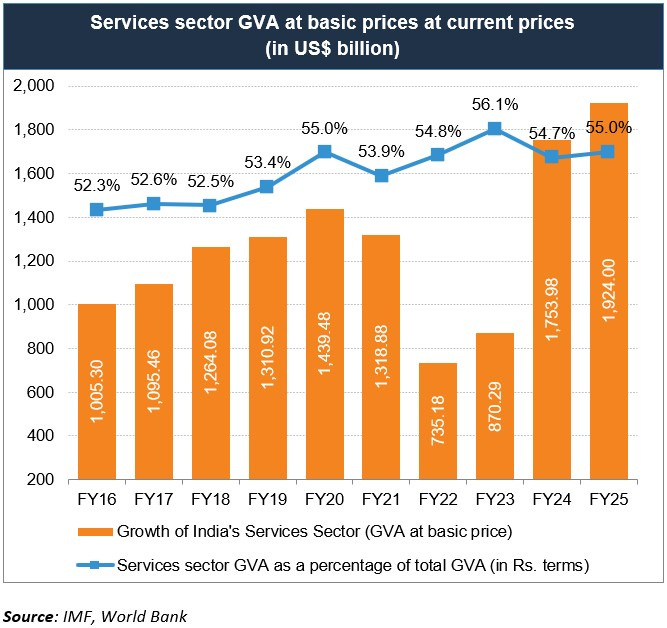
India became the back office of the world i.e. IT services, BPO, finance, accounting, software development, an export machine that today employs millions and generates hundreds of billions in foreign exchange.
That division is now being disrupted, simultaneously, by a single technology.
The question is not whether AI changes services. It will.
The question is whether India uses this moment to move decisively up the value chain or gets commoditised out of the very market it built.

The Wrong Lesson From China
Most people who cite China’s manufacturing success point to cheap labour.
They’re wrong. Tim Cook has been saying so since 2024.

China stopped being the world’s lowest-cost manufacturer a long time ago. Vietnamese factories are cheaper. Mexican factories are closer. And yet the world still makes things in China. Because China didn’t win on cost. It won on capability i.e. deep tooling expertise, precision engineering, supply chain coordination at scale.
The kind of industrial execution that only emerges when millions of people spend decades getting very, very good at a thing.
China became indispensable by becoming the best at manufacturing.
India needs to build the equivalent in services, and fast. And AI is the machine that makes it possible.
Our services industry is still largely selling on cost arbitrage. Indian salaries have risen to comparable global compensation standards. Remote work has globalised competition. AI is reducing the value of routine, repeatable labour.
India stopped being a low cost service provider sometime around covid, but our output quality is still lagging.
We seem to be stuck in a chalta hai (Hindi for “it’s fine”) attitude loop. Nahi chalta hai boss! (Hindi for “fine doesn’t work anymore, boss!”). We need to dramatically raise the bar on quality of services we provide domestically and internationally. Just “fine” doesn’t cut it in the AI age. That will require upskilling at a scale we’ve never seen before.

The next phase of India’s services story cannot be built on being cheaper.
It has to be built on being better. And delivering that better, faster than anyone else.
100x service provider: the leverage shift
The dominant narrative around AI in services is job displacement. AI writes the report. AI answers the query. AI files the document. Headcount falls.
There may or may not be truth to that - time will tell. But it’s the wrong frame for what India should be building toward.
The more important shift is leverage. AI doesn’t just automate tasks, it multiplies what a skilled professional can deliver in a given unit of time.
A wealth manager who serves 80 clients today may serve 200 or even 800 tomorrow. Not because she’s working harder. Because AI is handling the preparation i.e. portfolio reviews, market summaries, meeting notes, rebalancing recommendations and so on, and she’s spending her time on the judgment and relationship work that actually requires a human.
A compliance analyst who reviews 50 transaction alerts a day may review 500. Not because he’s faster at reading. Because AI has already triaged, categorised, and flagged the ones that actually need human attention.
1-min Feedback: Your feedback helps me improve this newsletter. Click UPVOTE 👍🏽 or DOWNVOTE 👎🏽
A loan underwriter who processes 20 applications a week may process 200. Because AI has already extracted and cross-validated the bank statements, GST filings, and income records before the file even reaches her desk.
This is not a future with fewer professionals. It is a future where the same professionals deliver dramatically more, faster, with higher accuracy, at lower marginal cost.
That is the leverage shift. And it is the foundation of India’s opportunity.
Speed in service delivery as a moat - old wine in a new bottle
In most industries, quality is the differentiator. In financial services, speed is quality.
At its core, financial services is an information-processing industry. Banks, insurers, wealth managers, asset managers, fintechs, regulators, they all spend enormous amounts of time reading documents, reviewing transactions, assessing risk, monitoring compliance, producing reports, communicating with customers. Every single one of those activities is changing fast.
Speed, powered by AI, is rapidly becoming the single most important competitive variable across every layer of financial services. And India is sitting on top of one of the largest pools of financial services talent in the world.
Let me go through the specific verticals where I think this plays out most clearly.
Wealth management. India’s wealth management industry has a coverage problem. There are tens of millions of households that have enough investable assets to warrant professional advice but not enough to justify the economics of a full-service relationship manager. AI changes that math entirely. One advisor with AI-assisted portfolio review, automated client communication, and AI-generated financial plans can cover a client base that previously required a team. The output quality goes up. The cost per client comes down. And the speed of response to market movements, to client queries, to rebalancing triggers, goes from days to minutes.
Lending. Credit underwriting in India is still painfully slow for most product segments. Fintech startups have improved this at the consumer end, but MSME and commercial lending still involves weeks of document collection, manual verification, and sequential review. AI compresses every step. Document extraction. Bank statement analysis. GST reconciliation. Bureau pull interpretation. Fraud signal detection. Each of these steps, which used to be done sequentially by different analysts, can now happen in parallel, in minutes. The underwriter’s job shifts from data collection to judgment. And judgment, applied with better information and less time pressure, produces better credit decisions.
Cross border and tax management: Indians are increasingly global citizens, working in the US, holding assets in Singapore, earning rental income in Dubai, managing an ESOP from a Cayman-incorporated startup. The tax implications of this are genuinely brutal. You need a CA in India who understands FEMA, an accountant in the US who understands FATCA, and someone who can reconcile the two without getting you into trouble in either jurisdiction. Today, that coordination is slow, expensive, and error-prone, because each professional is working in their own silo with their own tools. AI changes the coordination layer fundamentally. It can ingest income and asset information across jurisdictions, map applicable treaties, identify filing obligations across regimes, flag inconsistencies before they become compliance events, and generate jurisdiction-specific documentation for the CA or CPA to review and sign off on. The professional stays in the loop, liability and judgment remain with them, but the preparation work that used to take weeks collapses to hours. For the tens of millions of Indian professionals and entrepreneurs living globally, this is not a niche problem. It is a massive, underserved pain point.
Compliance. This is where I think India’s biggest opportunity sits, and it is underappreciated. Global financial institutions spend billions annually on KYC, AML, sanctions screening, transaction monitoring, and regulatory reporting. These are labour-intensive, rule-bound, data-heavy functions. They are exactly the functions where India already has scale — through GCCs, outsourcing firms, and consulting operations. And they are exactly the functions where AI provides the most dramatic throughput improvement. An AI-augmented compliance team does not just do the same work faster. It catches more. It files more accurately. It produces audit trails that are cleaner and more defensible. It turns compliance from a cost centre into a genuine competitive advantage for the institutions that get it right. India is positioned to be the delivery layer for this globally.
Insurance operations. Claims processing, medical record review, underwriting support — all operationally intensive, all heavily dependent on document interpretation, all changing fast. AI doesn’t replace the adjuster or the underwriter. It means the adjuster is spending time on genuinely complex claims and the underwriter is spending time on genuine risk judgment, not on extracting data from PDF attachments.
Investment research and fund operations. Portfolio monitoring, earnings transcript analysis, LP reporting, investment memo production, this is knowledge work that scales badly. A good analyst can only read so many filings. An AI-augmented analyst reads all of them and flags the ones that matter. India already has a deep bench of CFA-trained, IIM-educated analysts doing this work for global funds. AI turns each of them into a multiplier.
This is the future of knowledge work across every layer of financial services. And India has the talent base to lead it.
India’s second services wave
The first wave of India’s services exports was built on labour arbitrage. Send the work to India because the talent is cheaper. That was the pitch for IT services in the 1990s, for BPO in the 2000s, for GCCs in the 2010s. It worked. Enormously. But it was always a cost story.
The second wave is a capability story.
And it is broader than fintech. It spans every domain where India has built deep professional expertise and global client relationships i.e. legal, accounting, consulting, research, healthcare administration, hospitality, engineering services. The common thread across all of them is the same: skilled professionals, doing knowledge-intensive work, for global clients, at scale.
AI doesn’t disrupt that model. It supercharges it.
A legal services firm that drafts contracts doesn’t get replaced by AI, it uses AI to draft faster, review more thoroughly, and serve clients in more jurisdictions simultaneously. An accounting firm that handles cross-border tax compliance doesn’t get disintermediated, it uses AI to navigate multi-jurisdiction complexity that would have previously required three separate engagements. A consulting firm that produces market entry reports doesn’t get automated away, it uses AI to synthesise more data, with more rigour, in a fraction of the time.
In each case, the service is not merely software products. They are outcomes, delivered by professionals whose judgment, relationships, and domain expertise remain central, and whose leverage has been multiplied by AI.
This is what the second services wave looks like. Not AI replacing Indian professionals. Indian professionals using AI to deliver outcomes that were previously impossible at this speed, this quality, and this price point.
The companies that win this decade, in fintech, in legal, in accounting, in consulting, will be the ones that rebuild their delivery model around AI from the ground up. Not bolting AI onto existing workflows, but rethinking what the workflow looks like when AI is native to it. The pitch to global clients changes from “we are cheaper” to “we are faster, more accurate, and we get better every month.” India knows how to make a services pitch. It has been making one for thirty years. This is just a dramatically better version of it.
1-min Feedback: Your feedback helps me improve this newsletter. Click UPVOTE 👍🏽 or DOWNVOTE 👎🏽
The capability imperative
None of this is automatic.
China’s manufacturing throughput didn’t come from cheap labour. It came from decades of deliberate capability building and the discipline to obsess over quality until it became the default, not the aspiration.
India needs the same obsession. Not with cost. With capability building.
The winning wealth manager will be an AI wealth manager. The winning compliance officer will be an AI compliance officer. The winning CA handling cross-border tax will be one who has rebuilt their entire practice around AI, not someone who occasionally uses it to draft an email. These are professionals who understand what AI can and cannot do, and have redesigned their workflows around that understanding.
The underlying talent is here. The domain expertise is here. The client relationships are here. What’s needed now is the cultural shift, from selling hours to delivering outcomes, from competing on price to competing on quality and speed.
We don’t need to build our own large language models for this. We simply need to be the biggest users of AI models in the world. Tokenmaxxxing!

That is a harder change than adopting a new tool. But it is the change that determines whether India owns this opportunity or watches someone else build it.
The opportunity
For the past thirty years, India exported labour.
For the next thirty years, India can export leverage.
China became the world’s factory by combining people with machines and obsessing over throughput. India’s opportunity is to become the world’s services factory by combining people with AI and obsessing over speed & quality in every domain that runs the global economy.
The technology is increasingly becoming a commodity. The models will keep getting cheaper. Access will keep getting easier. What will remain scarce, genuinely scarce, is the ability to deploy that technology within a domain, with accuracy, at speed, in ways that hold up under regulatory scrutiny and institutional trust.
That is a services challenge. And India has spent thirty years building the foundations to lead it.
The question is not whether the opportunity is real.
It is whether we move fast enough to own it.
1-min Feedback: Your feedback helps me improve this newsletter. Click UPVOTE 👍🏽 or DOWNVOTE 👎🏽
🎵 Song on Loop
Good background songs to listen as you read Fintech Inside: This week I’d been obsessing over Olivia Dean and her song Dive (Spotify / Youtube). She’s got a beautiful voice and songs are easy listens. They’ve helped me get through deep work sessions. I’m literally writing this edition with Ms. Dean in the background. Here’s a bonus, hour long, live jazz session of her singing.
✨ Call Outs
[Travel] Mike Okay is my recent favourite travel vlogger. He’s currently in China.
[Travel] Itchy Boots is my other favourite travel vlogger. She rides a two wheeler across the world. From her vlogs I got to know that China
[Video] The Ridiculous Engineering Of Figma (ft. Figma Team)
[Video] How Stripe Built Their New Website
[Explainer] How a mechanical watch works
👋🏾 That’s All Folks
If you’ve made it this far - thanks! As always, you can always reach me via DM at osborne.vc/dm. I’d genuinely appreciate any and all feedback. If you liked what you read, please consider sharing or subscribing.
1-min Feedback: Your feedback helps me improve this newsletter. Click UPVOTE 👍🏽 or DOWNVOTE 👎🏽
See you in the next edition.
I'm absolutely with you on this. Question is -- what would be the pricing vs cost angle with AI? Logically, it should be price vs cost to do a task ... however, easier said than done given that orgs themselves don't track or know that. and cost to perform the task will keep reducing given advances in AI ... 1st wave of services was a lot easier from price vs cost perspective... we can offer same / better quality resource (for a defined set of work) at 1/x your cost ... for the 2nd wave of services with AI, I'm not sure the world has answers. any ideas on that?